Leisure and learning, in that order.
Kids who use alternative access often get fewer chances than their peers to just try things and find out what they enjoy. Every game here exists to close that gap first. The skill-building and the data are real, but they're what happens along the way, not the reason a child opens the game.
"Every category on this page maps to something I'd write on a treatment plan: visual scanning, motor planning, cause and effect, structured choice making. The games don't feel clinical because they aren't dressed up as therapy. But the skill practice is real, and it's intentional in every one."Occupational therapist and founder, AdaptiveTech OT
Not another drill library.
Most accessible-game sites are built around short, repeated cause-and-effect drills. Useful, but rarely fun for long. We started from a different question: what if the accessible version was also just a genuinely good game?
Real games, start to finish
A full sports arcade, a branching mystery story, a living aquarium. These are games kids choose to keep playing, not activities they tolerate.
Free while in beta
No countdown, no procurement process. Open a browser and play, the same way you'd hand any kid any other game. A paid membership is planned once the beta ends; today, honest feedback is the price of admission.
Built on a real clinical framework
Every category is designed around operational, social, and psychosocial competence, the same framework speech-language pathologists use for AAC learners. More on that below.
Graded challenge, not blanket no-fail.
Difficulty across the library is a spectrum on purpose. Starting Simple and Creative sit at the gentle, zero-stakes end; Sports, Targeting, and Adventure sit at the other end, with real timing pressure and win/lose outcomes, because a child who wants to get better at something needs a challenge that can actually be missed. This follows the "just-right challenge" from Ayres Sensory Integration research: real engagement lives between too easy and too hard, not at the safest possible setting.
🧠 The framework behind the categories
Light & McNaughton's model of communicative competence for AAC users describes four interlocking domains: operational (the physical skill of running the access method itself), social (using it with and around other people), linguistic, and strategic competence. The model was later expanded to include psychosocial factors like motivation, confidence, and resilience, which it treats as just as essential as the mechanical skill itself.
Every category below was built with those domains in mind, not as therapy dressed up as a game, but as genuinely fun play that happens to build the same competence a clinician is already targeting.
Light, J., & McNaughton, D. (2014). Communicative Competence for Individuals who require Augmentative and Alternative Communication. Augmentative and Alternative Communication.
Nine categories: what's in them, and who they're for.
Every category is scalable by speed, target size, and access method, so it can meet a child at very different starting points.
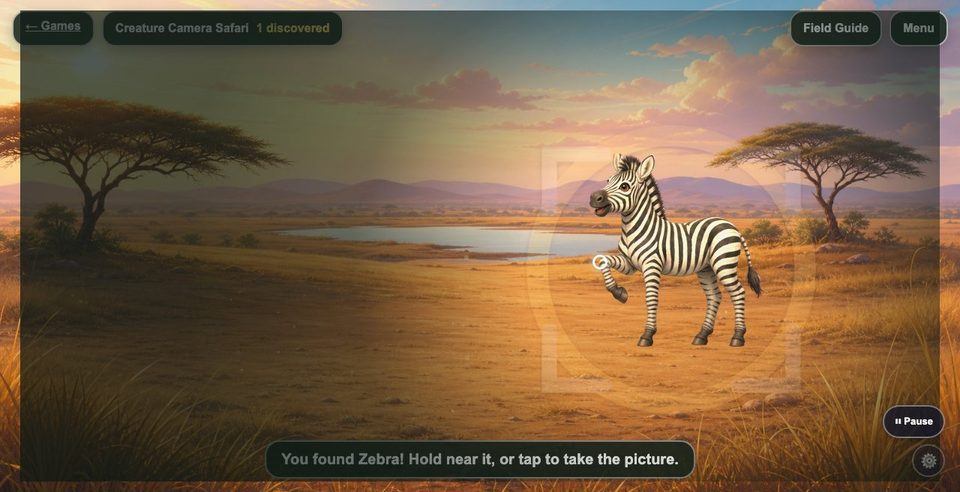
Starting Simple
No goals, no losing. A gentle first try with a new device or access method.
Sparkles follow your gaze, a mole boops down, a bird shows up to say hello. Small, satisfying "I did that" moments with nothing to get wrong.
A safe first handoff of the cursor or eye tracker. Nothing to fail at, so the first session doesn't end in frustration for either of you.
Targets the psychosocial groundwork Light & McNaughton flag as foundational: motivation and confidence, before any operational skill can build on top of it.
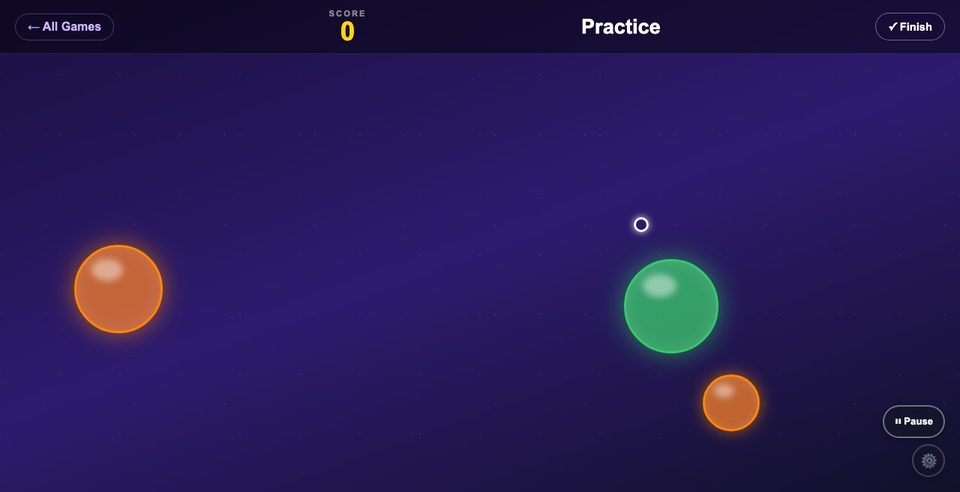
Targeting
Spot it, hit it. Pick a size and speed that's just right.
Pop, catch, blast: quick, arcade-satisfying wins that feel like a game, not a worksheet with a timer.
Fast, visible proof of progress every session, and an easy score or streak to celebrate together.
Pure operational competence: scan, fixate, confirm. The literal mechanics behind eye-gaze and AAC access, gradeable by size and speed.
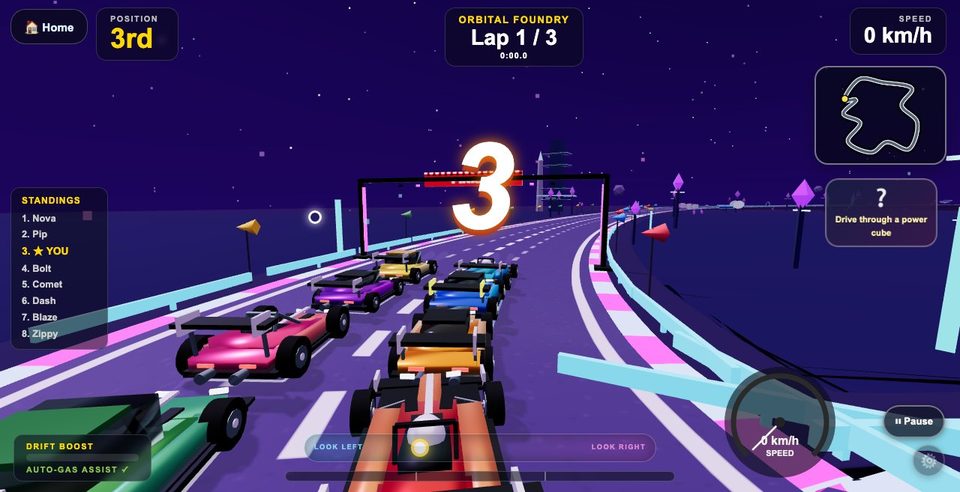
Adventure & Exploration
Smooth, steady moves through a world worth exploring.
Real worlds to steer through: a rally track, a redwood forest, a delivery route. A reason to keep going, not just tap once and stop.
Longer, more engaged play sessions that feel like an adventure rather than a repeated drill.
Builds sustained, continuous access-method control: stamina for functional device use across a whole activity, not just isolated trials.
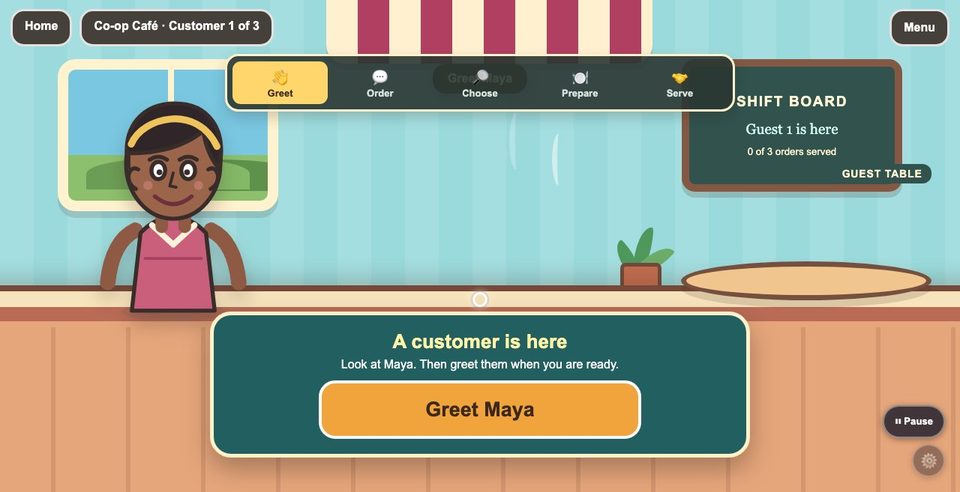
Choice-Making
Look at the one you want, and it's yours.
Real agency: pick the snack, the toy, the order, and watch the choice actually happen.
Everyday choice-making practice that transfers off-screen: what to eat, what to wear, what to play next.
Directly rehearses the look-across-the-array-and-confirm pattern behind direct-selection AAC access; Co-op Café layers in social competence: sequencing a shared task with a partner.
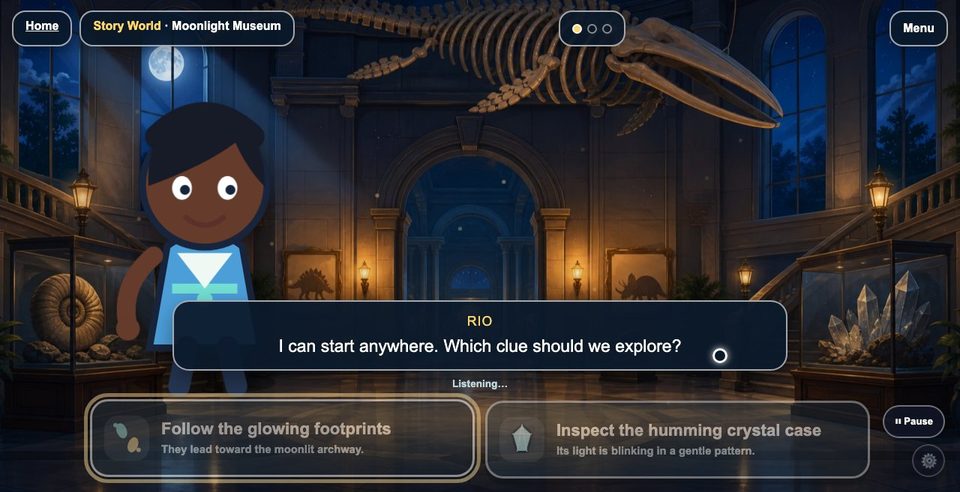
Puzzles
Stories, matching, and memory to work through at your own pace.
Stories to steer and mysteries to solve. A reason to feel clever, not just fast.
Quiet, focused time that still feels like real play, at whatever pace your child sets.
Sequencing, working memory, and multi-step problem-solving: narrative comprehension in Story World, pattern recall in Memory Match.
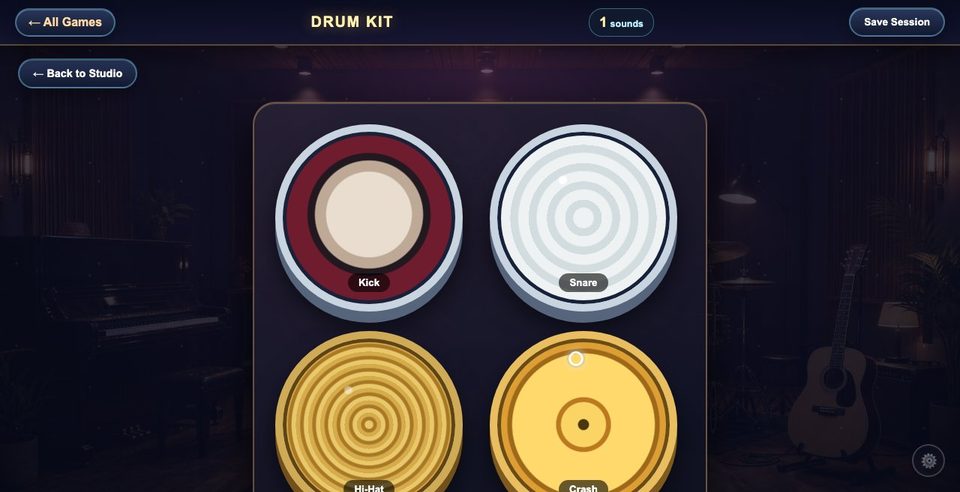
Creative
Open-ended music and art. No wrong answers, no score.
Nothing to get wrong. Just making a sound or a picture and watching it happen.
A calm-down option, and proof that screen time can be for something other than scoring points.
Directly addresses the psychosocial side of the framework, motivation and confidence, through pressure-free, self-directed expression.
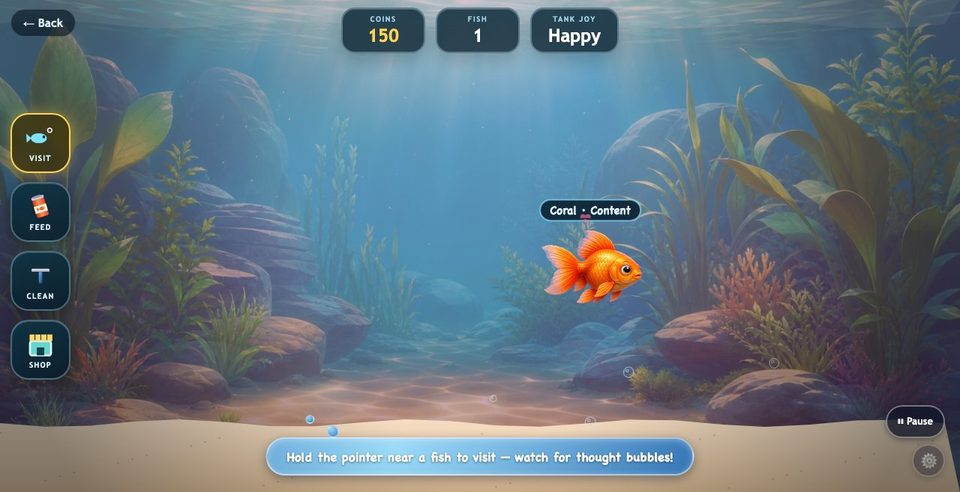
Nurture & Care
Feed it, tend it, watch it grow over time.
Something that's genuinely theirs to keep coming back to and watch grow, visit after visit.
A built-in reason to return tomorrow, and a gentle first lesson in caring for something outside themselves.
Reinforces operational competence through low-stakes repetition, while building delayed gratification and a sense of continuity between sessions.
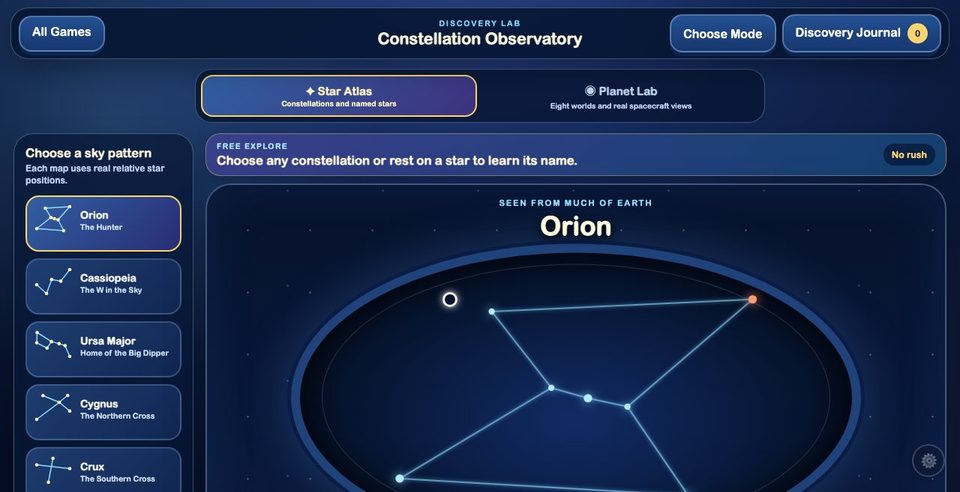
Real-World Discovery
Explore real subjects like the sky, animals, and places, because they're fascinating, not because there's a quiz.
Real constellations and planets to wander through at their own pace: free exploration, gentle guided hints, or an untimed find-them-all hunt.
A place to discover an actual interest, not just practice a skill. The start of "my kid loves space" instead of "my kid is good at this game."
The clearest embodiment of leisure exploration in the library: identifying interests and building personal causation, not task completion, is the explicit design goal. See the Research page.
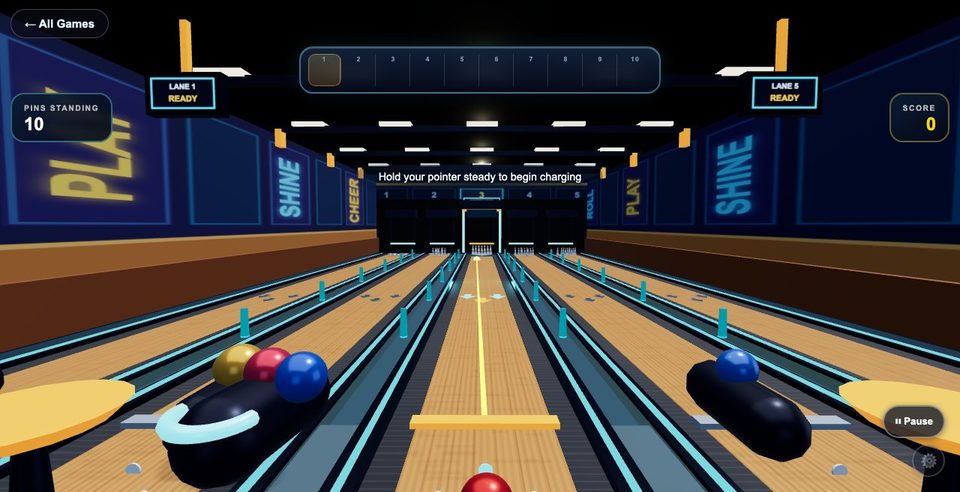
Sports
Aim, hold still to charge your power, and go. No fast reflexes needed.
The big, loud, high-five-worthy wins: a strike, a goal, a breakaway. Full arcade energy.
A genuinely exciting "watch this!" moment to share, not just an educational milestone.
Separates aim from timing: motor planning and sustained fixation without reaction-time pressure, while still delivering the psychosocial payoff of real achievement.
A note on switch access: everything above is played by moving a cursor, whether that's eye gaze, joystick, head mouse, touch, or mouse. Scanning-style switch access is not supported yet; we'd rather say so plainly than imply it works before it has been tested with real users.
A few ways this shows up in real sessions.
A warm-up or a reward
Starting Simple or Creative titles work well to open a session calmly; Sports or Targeting work as an earned, high-energy close.
Carryover at home
Every game is browser-based, and free while the beta runs, so a family can practice the exact same access pattern between sessions with no new hardware.
Data, without turning play into a task
The Growth Report quietly summarizes accuracy, session length, and choices made across every game. It's there if you want it for documentation, but never something a child feels while they're playing.
Want the research behind it?
The evidence and clinical framing behind every category, in one place.