Why we build it this way.
The graded difficulty, the category structure, the dwell-to-select pattern: every design choice on this site traces back to research on play, motor learning, and augmentative communication. Here's the actual evidence, not just the pitch.
Play isn't a reward you earn after the real work. In OT, it is the work.
The American Occupational Therapy Association's practice framework names play as one of just eight official areas of occupation, on the same level as self-care and work. Occupational therapist Anita Bundy's research goes further, defining playfulness itself as a measurable trait: spontaneity, imagination, creativity, and lightheartedness, not just the presence of a game.
Play is the occupation of childhood
Pediatric OT treats participation in play as a central goal in its own right, not a delivery vehicle for something else. That's the standard we designed every category against.
Playfulness is designable
Bundy's model treats playfulness, the freedom to explore, choose, and suspend reality, as something an environment can support or shut down. No-fail mechanics and open-ended Creative titles exist because of this.
Games as a therapeutic tool
Separate OT and rehabilitation research shows video games' built-in feedback loops and storylines drive real motivation and adherence. That's a big part of why we built full games instead of flashcard-style drills.
Leisure exploration: finding out what you actually like.
OT practice treats "leisure exploration" as its own distinct skill: identifying interests, trying new activities, and discovering what's actually enjoyable, separate from just building a skill. For kids who use alternative access, that kind of exploration is often the first thing to disappear.
A documented exposure gap
Research on kids with communication and mobility limitations finds their leisure participation falls behind peers, and the gap widens further between ages 8 and 12, right when interests and hobbies normally start to take shape.
Interests take exposure to find
Kielhofner's Model of Human Occupation describes interests and "personal causation", a sense of being able to make things happen, as capacities that fade through disuse if a person never gets the chance to try things and see what sticks.
Why nine categories, not one
Sports, storytelling, music, pet care, real constellations. The category range exists so a child can sample genuinely different kinds of fun, the same way a typically-developing kid tries out soccer, art class, or a new video game, and finds out what's actually theirs.
🔭 The clearest example: Real-World Discovery
This category exists almost entirely to serve leisure exploration directly. Titles like Constellation Observatory aren't built around a single skill drill. They hand a child real constellations, real planets, and real facts to wander through freely, follow gentle guided hints, or take on as an untimed challenge. The goal stated in its own design brief: help a child "encounter new interests, develop preferences, and experience the pleasure of exploring something because it is fascinating", not to produce data or complete a task. Any insight a therapist gains into a child's interests or access patterns is a byproduct, never the point.
Play isn't a break from development. It's how development happens.
Kids with physical or cognitive disabilities are less likely to get equal access to play than their peers. The research on what that costs them, and what happens when access improves, is consistent.
Social integration
Play and recreation act as a catalyst for friendships, belonging, and social skill development, not just physical benefit.
Resilience & achievement
Structured play and recreational activity build a real sense of achievement and coping skills, particularly for kids managing a chronic condition or disability.
Cognitive & emotional growth
Play builds creativity, problem-solving, and emotional regulation, and has been shown to improve school learning readiness.
Operational, social, and psychosocial competence.
Every category in the games library is built around a model developed for augmentative and alternative communication (AAC), not because every player uses AAC, but because the underlying skills (access-method control, social use of that access, and the confidence to keep trying) generalize far beyond it.
🎯 Operational competence
The physical skill of running an access method itself (direct selection, eye gaze, joystick control), independent of what it's being used for. This is what Targeting- and Sports-category games are built to practice directly.
🤝 Social competence
Using an access method with and around other people: turn-taking, shared attention, cooperative sequencing. Co-op Café's partner mode is built specifically for this.
🗣️ Linguistic competence
The language knowledge behind meaningful communication. Choice-Making games rehearse the scan-and-confirm structure this depends on, without requiring an actual AAC vocabulary.
💛 Psychosocial factors
Added to the model in 2003: motivation, confidence, identity, and resilience. Starting Simple and Creative categories exist almost entirely to build this. The will to keep trying, not just the mechanical skill.
The just-right challenge.
The instinct when designing for kids with disabilities is to make everything maximally forgiving. Sensory integration research says that's actually a mistake: engagement lives in the space between too easy and too hard, not at the safe end of that scale.
Boredom on one side, frustration on the other
A. Jean Ayres, the founder of Ayres Sensory Integration®, described real engagement as flourishing between the boredom of too easy and the frustration of too difficult, not by removing difficulty entirely.
No-fail has its place
Starting Simple and open-ended Creative titles sit deliberately at the gentle end: a calm, zero-stakes entry point, not the library's default setting.
Real stakes have their place too
Sports, Targeting, and Adventure titles sit deliberately at the other end: timing pressure, a shot to land, a level to beat. Mastering something that could actually be missed is what makes winning mean something.
How this shows up in the actual games.
Difficulty is a spectrum, not a switch
Every category sits somewhere different on the just-right challenge scale on purpose. The library doesn't default every mechanic to the safest possible setting.
Graded within each game too
Size, speed, and timing are adjustable in almost every game, so one category can still meet a child anywhere on a skill continuum instead of one fixed difficulty for everyone.
Dwell-to-select everywhere
The same core interaction pattern used across every game mirrors real AAC and eye-gaze device operation, so practice here transfers to everyday device use.
Further reading.
The research this page draws from, for anyone who wants to go deeper.
-
A Qualitative Exploration of the Therapeutic Characteristics of the Art of Therapy: Perspectives on Ayres Sensory Integration. PMC.
Describes the "just-right challenge" central to Ayres Sensory Integration®: real engagement flourishes between the boredom of too easy and the frustration of too difficult. That's the basis for grading difficulty across categories instead of defaulting everything to no-fail.
-
Bundy, A., & Kuhaneck, H. (2024). The Occupation of Play. American Journal of Occupational Therapy.
Defines playfulness (spontaneity, imagination, creativity, lightheartedness) as a measurable, designable trait of an environment, and play as a core pediatric OT goal in its own right.
-
Commercial Video Games As Therapy: A New Research Agenda to Unlock the Potential of a Global Pastime. PMC.
Video games' built-in feedback loops and storylines drive real motivation, engagement, and treatment adherence. That's the case for building full games instead of isolated drills.
-
Light, J., & McNaughton, D. (2014). Communicative Competence for Individuals who require Augmentative and Alternative Communication. Augmentative and Alternative Communication.
Defines the operational, linguistic, social, and strategic competence model, later expanded to include psychosocial factors like motivation and resilience. It's the framework behind this site's category design.
-
Improving Health in Children with Disabilities: An Intervention-Development Study to Support Participation in Leisure in 8–12 Year Olds with Communication and Mobility Limitations. PMC.
Leisure participation for kids with communication and mobility limitations falls behind peers, and the gap widens specifically between ages 8 and 12.
-
Kielhofner, G., & Forsyth, K. (1997). The Model of Human Occupation: An Overview of Current Concepts. British Journal of Occupational Therapy.
Interests and "personal causation", the sense of being able to make things happen, are capacities that fade through disuse without the chance to try new activities and find what fits.
-
Exploring Physical Activity in Children and Adolescents with Disabilities: A Bibliometric Review. PMC.
Reviews the physiological and psychosocial benefits of physical activity for kids with disabilities, and the persistent access gap compared to peers.
-
Physical and Psychosocial Benefits of Sports Participation Among Children and Adolescents with Chronic Diseases: A Systematic Review. PMC.
Structured, achievable recreational activity builds resilience, coping skills, and social integration for kids managing a chronic condition or disability.
-
The Importance of Play for Children With Autism, Cerebral Palsy, and Intellectual Disability. ResearchGate.
Play builds creativity, imagination, and cognitive and emotional strength, and improves learning readiness and problem-solving in school settings.
Real gameplay, not just descriptions.
Each of these is a real moment pulled from the actual games: the same graded-challenge spectrum described above, shown rather than just claimed.
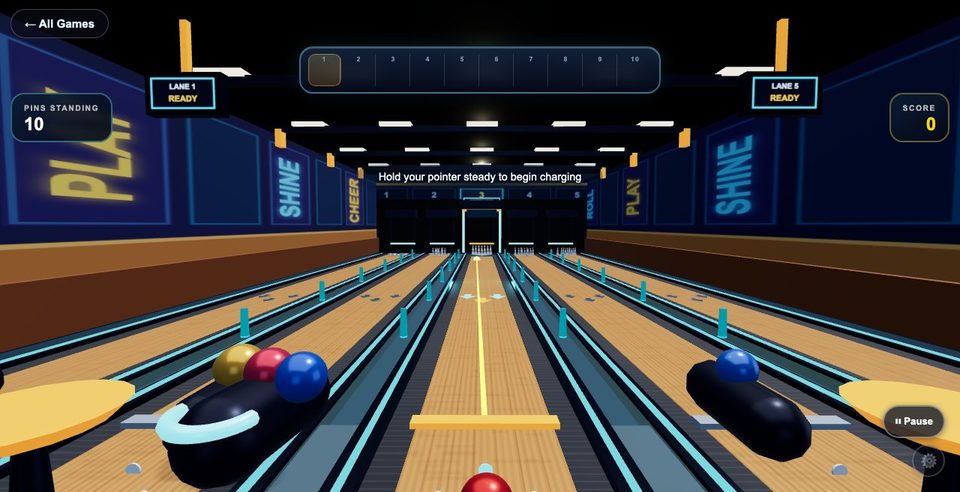 Real stakes: Bowling Alley
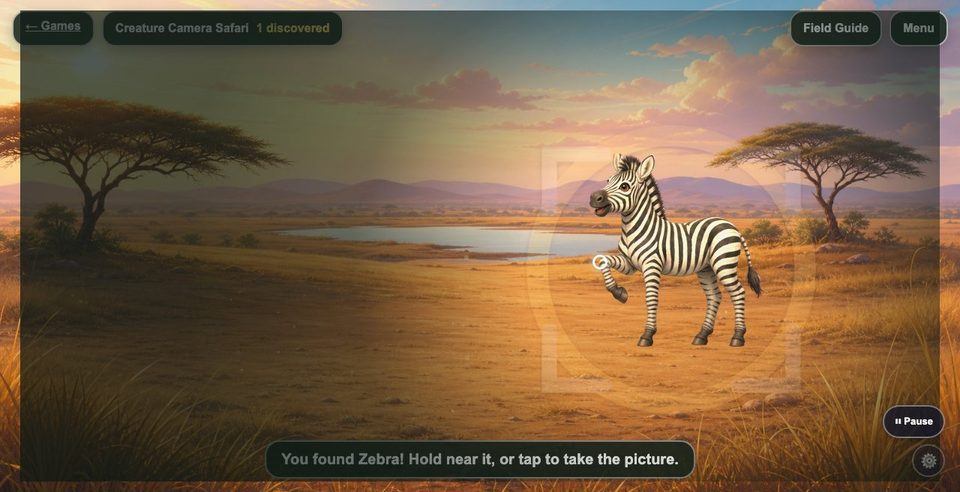 No-fail: Creature Camera Safari
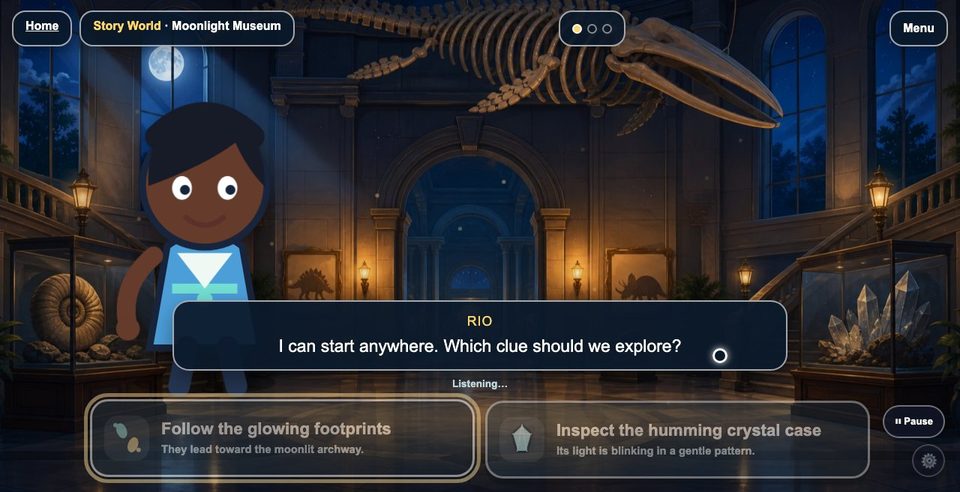 Story World, mid-mystery
See how it plays out in the games.
The full category breakdown, mapped to players, parents, and therapists.